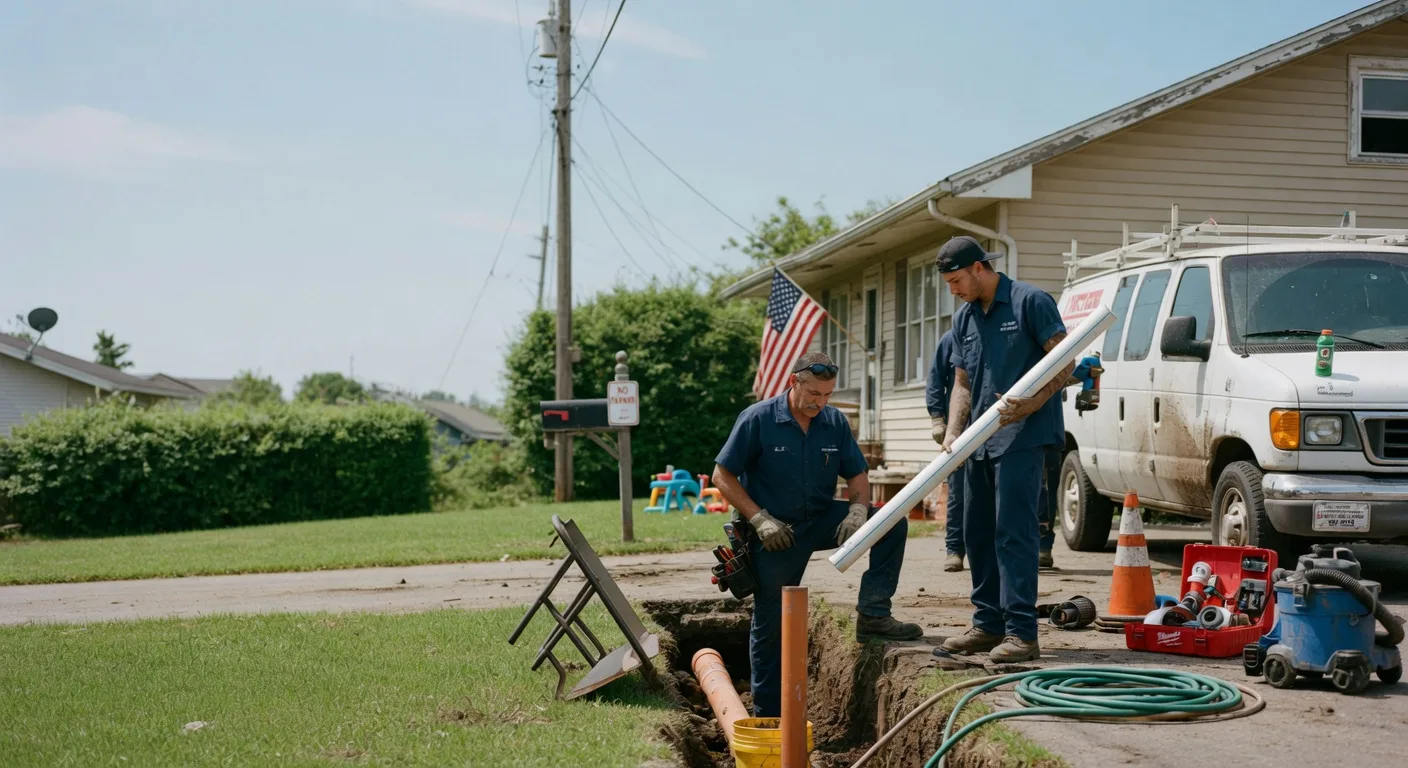
How often does a main sewer line actually need cleaning?
There is no set interval that fits every house. A main sewer line in good shape, with no symptoms, does not need cleaning on a calendar. A line with a known problem often does.
The usual reasons a main line needs repeat attention are root intrusion at a clay or loose joint, grease build-up on the pipe wall, or a bellied section that holds water and collects solids. Those problems do not go away after one cleaning. Roots regrow. A belly keeps holding water. A line like that may need cleaning on a schedule that suits what is found in it.
The way to set that schedule is a camera inspection. It shows the cause, the condition of the pipe and where the trouble sits, so the interval is based on what is in the line and not a guess.
Watch for the signs: slow drains in several fixtures, gurgling, a sewage smell, or the lowest drain in the house backing up. One slow sink is usually a branch line job. Several fixtures at once points to the main.
A cable machine is often enough for roots and soft blockage. Heavy grease or scale needs hydro jetting. A failed sewer lateral needs repair, not cleaning, and cost then depends on access, the materials, how much is opened up and any permit required. If sewage is backing up, stop running water and call. Expert Plumbers Co is a referral service. We refer you to a local plumber for Drain Cleaning or Emergency Drain Cleaning in Creighton, MO: (380) 262-9173.
What you notice between cleanings is more useful than the date on the calendar. Keep a simple note of when drains slow, when gurgling starts and how long each cleaning lasted. If the gap between problems keeps shrinking, the cause is getting worse and a camera inspection should come before the next cleaning. Older homes with clay or cast iron mains often show roots or scale returning within a year or two, while newer plastic mains usually stay clear much longer unless a joint has shifted or something was flushed that should not have been. A common mistake is paying for repeated cleanings without ever seeing the inside of the pipe. After a thorough cleaning and inspection, ask the plumber what the line looked like, how much was removed and when it makes sense to look again, so you leave with a plan.
Water comes up in my bathtub when the shower or the sink next to it is running. What does that mean?
When water appears in the tub while another fixture runs, the drain water has nowhere to go and is finding the lowest open drain in the bathroom, which is usually the tub. It means the shared drain line past those fixtures is restricted. It is not a tub problem.
The tub drain sits low and connects to the same branch as the sink and often the toilet. If a clog, a bellied pipe holding water, or roots at a joint slows that branch, the extra flow from the sink backs up through the tub drain. A tub that gurgles or burps is showing you the same thing.
The timing tells you something. If it happens only when the sink runs, the blockage may be in that shared branch. If it also happens when the washing machine or a toilet elsewhere in the house is used, the main drain is the likelier suspect, and the whole line is slowing down.
Safe checks you can do: run the sink alone and watch the tub, then run the shower alone and watch the sink. Check whether a basement floor drain or other low drain shows water too. Pull the tub stopper or strainer and clear any hair. Do not keep running water to see how bad it gets, and do not use chemical cleaner in a drain that is already backing up, since the liquid can come back up to your skin.
A cable machine often clears a soft clog in a branch line. If the backup returns, it needs a camera inspection to show whether roots, a bellied section, or a damaged joint is behind it, and hydro jetting may be the next step for grease or heavy buildup on the pipe wall.
Stop running water and call right away if the water in the tub is dark or smells like sewage, if it rises when you flush, or if other drains in the house are slow. That points to the main sewer line, and wastewater is a health risk. Keep children and pets out of the bathroom.
Cost depends on access, how far the blockage sits, whether a cleanout is available, and how much has to be opened or replaced.
Expert Plumbers Co can connect you with an independent local plumber in Creighton, MO when you call (380) 262-9173.
Can I watch the camera footage from my sewer line, and what should I ask the plumber to show me?
Yes, you can ask, and a plumber who does this work properly will usually be glad to show you. The picture is the clearest evidence there is of what is happening inside a pipe you cannot see.
Most inspection cameras feed a small monitor at the cleanout or a tablet held by the plumber. Ask to watch it live. Ask to see the footage again afterward, and whether it was recorded. A recording matters if you later need a second opinion, a repair quote from another plumber, or a record for a home sale.
Here is what to ask to see.
The start of the run. A clean, round pipe wall tells you the line was open and what material it is, such as clay, cast iron or plastic.
Any joint that looks offset, cracked or separated. Ask the plumber to pause on it.
Root growth. Fine roots look like hair or threads at a joint. Heavy roots fill the pipe like rope.
Standing water. A section that holds water is a bellied line, a low spot where debris collects. Ask how long the section is.
Scale or heavy buildup, especially in cast iron, where the wall looks rough and lumpy.
The end of the run. Where did the camera stop, and why? A collapse, a hard blockage, or a break all look different.
Then ask how far from the cleanout each problem sits. Many cameras carry a footage counter or a locator that finds the spot from above. That distance is what tells you how much digging a repair might involve.
A few cautions are worth knowing. The image can look worse on a small screen than it is, and a single hairline crack is not the same as a collapse. A plumber should be able to say which it is and what it means for the next step. If the camera could not pass a blockage, ask what is beyond it, because the camera has only seen part of the line.
What camera work adds to a visit depends on access and how long the run is, and it often heads off a repair based on a guess.
If you need a drain cleared in Creighton, MO, Expert Plumbers Co can connect you with an independent local plumber at (380) 262-9173.
The furnace or air conditioner drains into my basement floor drain and now it overflows. Is that a drain cleaning job?
"The furnace drains into my basement floor drain and now it overflows." That is a common one, and it is a drain problem with two parts. The overflow can come from either end: the small condensate line, or the floor drain it empties into.
Condensate lines clog with algae and sludge. Once it blocks, water backs up at the unit or spills from the line onto the floor. Many systems also have a trap on that line, and the trap is the first place sludge collects.
The floor drain itself can be the problem. If it is slow or backs up when you run the washer or a tub upstairs, the cause is in the house drain: grease build-up, a bellied line holding water, or root intrusion at a clay joint further out.
One slow floor drain, with the rest of the house draining fine, usually means a local blockage in that branch. Every drain in the house backing up, or the lowest drain gurgling and rising while others run, points to the main line or a failed sewer lateral.
Safe homeowner check: Look at the pipe from the unit. Is water standing in the pan or trap? Pour a bucket of water into the floor drain and watch how fast it goes. Do not pour bleach or drain chemicals into the condensate line without knowing the unit's instructions.
Stop running water and call now if the floor drain is bringing up sewage or a sewer smell, other drains in the house are slow or gurgling, water is spreading toward electrical equipment or the furnace, or the overflow comes back soon after you clear it.
A cable machine is often enough for a plain clog in the floor drain branch. A condensate line is a different job: it needs flushing or clearing at the line and trap, and may need a cleanout fitting added. If the floor drain keeps backing up, a camera inspection shows whether the main line has roots or a belly. Hydro jetting is used when grease or scale coats the pipe wall.
Expert Plumbers Co is a referral service. We connect you with an independent local plumber in Creighton, MO. Call (380) 262-9173.
Ask the plumber to check both the condensate line and the floor drain, and to explain which one failed. Ask whether the condensate should drain somewhere else, since rules vary by area on where it may discharge. Cost depends on access, the parts needed, how much has to be opened up or removed, and any permit or code requirement.
We wash the dog or muddy gear in the tub or laundry sink. Can sand and mud clog the line?
Washing the dog in the tub feels harmless. The water runs away, the bathroom smells of wet fur, and an hour later the tub drains slowly. Muddy boots, gardening gear and sports kit in the laundry sink do the same thing over time. Yes, sand and mud can clog a line.
The problem is how they travel. Water carries sand and grit along, but only while it is moving fast. In a trap, a flat run or a low spot in the pipe, the flow slows and the grit drops out. It settles, packs down and mixes with pet hair, soap and grease to form a dense sludge. Each wash adds a little more. Eventually the pipe is narrow enough that normal use overflows it at peak load.
Hair and grit also catch on any rough spot, such as scale in cast iron or a root mat at a clay joint, and a bellied line holds the settled material in place. It does not flush away on its own.
The key question is where it is happening. If only the tub or laundry sink drains slowly, the clog is likely in that fixture's trap or branch line. If the toilets gurgle and other drains back up as well, the sludge has moved into the main.
Safe homeowner check: stop washing pets or gear in the tub and laundry sink for now. Fit a fine hair catcher over the drain. Use a bucket and the yard hose for muddy boots and dog baths outside when weather allows. Do not pour chemical drain cleaners into a line with packed sand, since they do not dissolve it.
Stop running water and call now if sewage or gray water is coming up in a tub or floor drain, if the drain is overflowing, or if you smell sewage. Do not keep running the washer while the line is backed up.
A cable machine can open a path through packed sludge, but it often leaves settled sand behind, so the drain slows again. Hydro jetting flushes the sand and mud out of the line. If the trouble keeps returning, a camera inspection shows whether a belly, root intrusion or damaged joint is trapping it.
Expert Plumbers Co is a referral service. We connect you with an independent local plumber in Creighton, MO. Call (380) 262-9173.
Tell the plumber exactly what goes down the drain, including pet washing. Ask whether the trap was cleaned and whether the main was jetted or only cabled. Scope depends on access, how far the buildup extends, whether a section has to be opened up, and any permit or code requirement for repairs. A cleanout near the fixtures makes future service simpler.